
 Image 1 of 1
Further Information
Application
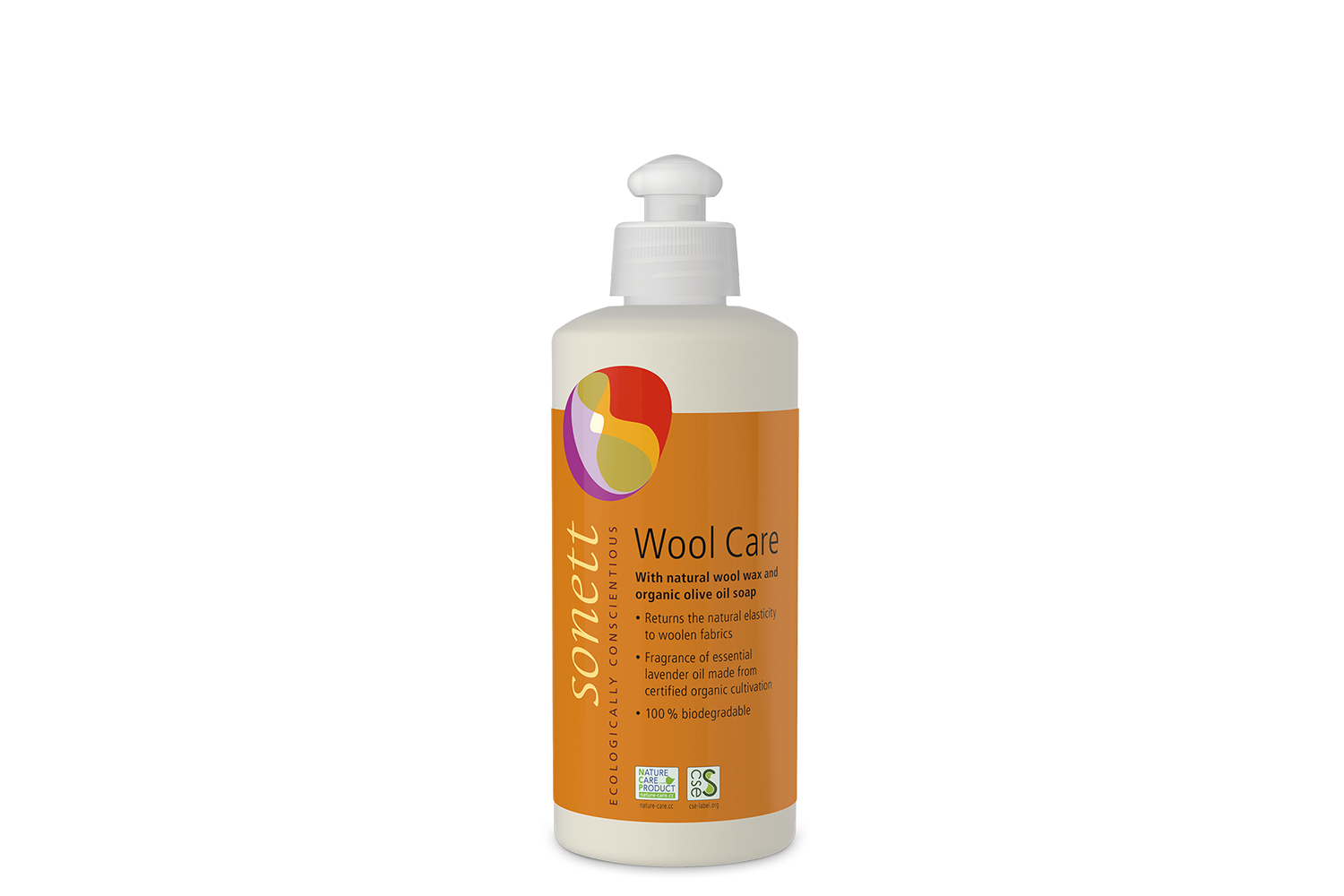
Special product feature The wool wax used is of pharmacopoeial quality. Thanks to the inclusion of olive-oil soap and sugar surfactant, Wool Care may also be used, without problems, in areas with hard-water.
The olive oil and the essential oil of lavender are 100% derived from certified organic cultivation.
Ranges of application
For lipid replenishing of highly stressed garments made from wool and for woollen nappy pants.
Application
For lipid replenishing of highly stressed garments made from wool and silk.
Particularly important for babies’ woollen nappy pants which, due to the natural wool-wax content, collect the dampness from the diaper while still remaining permeable to air. If babies’ woollen nappy pants are washed, they lose their naturally occurring wool fat. Regular application of Wool Care replenishes the wool with the wool wax it needs for proper functioning.
Dosage woollen nappy pants Dissolve 1–2 tablespoon of Wool Care in hot water and fill up to approx. 1 litre (34 fl oz US) using cold water. Place the moistened woollen nappy pants into the lukewarm solution, wash through several times and leave to soak for about ½ to 1 hour. Rinse in lukewarm water, press out and leave to dry on a towel.
Dosage stressed woollen clothing, such as jackets, milled jackets, wool-felt hats, jumpers, etc. Dissolve ½ teaspoon of Wool Care in hot water and proceed as described above.
Wool Care can also be used in the washing machine. To this end, dissolve ½ teaspoonful of Wool Care in approx. 30–40 ml (1–1.4 fl oz US) of hot water and pour the solution into the fabric softener compartment of the washing machine.
Ingredients
Product declaration Natural wool fat (pesticide-free) 15–30%
Olive-oil soap, certified organically grown 15–30%
Sugar surfactant 5–15%
Cetyl alcohol 1–5%
Plant-based thickening agent <1% data-preserve-html-node="true"
Citrate <1% data-preserve-html-node="true"
Essential lavender oil, certified organically grown <1% data-preserve-html-node="true"
Balsamic additives, certified organically grown / collection from wild-growing plants <1% data-preserve-html-node="true"
Water up to 100%
List of ingredients as per EC 648/2004 Aqua, lanolin, potassium soap, alkylpolyglucoside C8–C16 (coco glucoside), cetyl alcohol, polysaccharide (xanthan gum), sodium/potassium citrate, parfum, linalool certified organically grown
Origin and properties of the ingredients Wool wax is obtained from freshly shorn sheep’s wool that underwent a special process to remove any pesticide and herbicide residues. In order to be well dispersed in the water and to adhere to the fibres, the wool wax must be emulsified into fine droplets using olive-oil soap and sugar surfactant. Sugar, coconut oil and palm oil are the raw materials used to manufacture sugar surfactant. Olive soap results from the chemical reaction between olive oil and lye (alkaline solution). Olive oil is the best oil raw material for making mild lipid-replenishing plant-based soap. Its well-balanced composition of fatty acids, its healing balancing effect on the cardiovascular system, and the remarkable growth of the olive tree in a 7-year cycle are evidence of the special proximity and relationship of this oil to humans. Cetyl alcohol–obtained from palm oil – and the plant-based thickening agent enhance the emulsifying effect of sugar surfactant and olive oil soap.
Technical data Density: 20 °C approx. 0.99 g / cm³ 68 °F approx. 0.035 oz / in³ pH value: 20 °C, 5 g / litre H₂O 68 °F, 0.18 oz / 34 fl oz US H₂O approx. 7–8
Ecology
Biodegradability The raw materials wool wax and cetyl alcohol are, in finely emulsified state, readily micro-biodegradable. Soap made from vegetable oils has one outstanding feature compared to all the other active washing substances, namely that, right after its use, it reacts chemically with the limescale always present in waste water, forming calcium soap, thus neutralising its effect on live organisms (primary degradation). The calcium soap is then, micro-organically, 100% degraded into carbon dioxide and water (secondary degradation). Despite the fact that during the manufacturing of sugar surfactants, constituents are being extracted from the plant-based raw materials starch, sugar, and fat, they remain completely intact in their chemical structure. For this reason it is so easy for the microorganisms to 100% decompose these surfactants into CO₂ und H₂O very rapidly. Soap, sugar surfactant, and cetyl alcohol are classified as being readily biodegradable according to OECD guidelines.
Suitable for septic tanks and filtration systems.
Certification Ecogarantie CSE (Certified Sustainable Economics) Packaging Bottle: PE Label, cap: PE / PP
Have you tried?

30° 60° 95°C
Lavender
Component 1 in the Sonett Modular System
With organic vegetable oil soap, without enzymes, GMO-free
Good washing performance,suitable for white and coloured textiles
Lovely fragrance of essential lavender oil from certified organic cultivation
100% biodegradable
Available in: 2 litre, 10 litre

Component 3 in the Sonett Modular System
With pure oxygen, without petrochemical substances
For all washable white and colourfast textiles made from cotton, linen, hemp and mixed fabrics
Removes all oxidizable stains such as fruit, red wine, tea, coffee, grass, blood, etc.
Prevents the greying of white laundry
Brightens up yellowed and greyish laundry
Available in: 450 g & 5 kg

Highly effective liquid for removing stains and spots
With organic plant oil soap
Essential oil of petitgrain from organic cultivation
Effective against fruit, blood, grass, ink, oil or grease stains etc.
100% biodegradable
Available in: 120 ml, 300 ml and also available in Soap bar 200g

Suitable for hands, face and body
Made from 100% certified organic vegetable oils
100% biodegradable
Available in: 300 ml & 1 litre